

From Automation to Autonomy: Building the AI-Powered Fleet
Autonomous, network-aware freight procurement is emerging as a key competitive advantage for motor carriers.
Two pressing questions in transportation today are: “Where should I use AI?” and “What is an AI-powered fleet?”
Consensus is elusive. Ask 10 people across the industry, and you’ll likely get 10 different answers.
Increasingly, fleets use AI agents to automate repetitive tasks across customer and driver communications and back-office operations. Others are pursuing more disruptive technologies, such as autonomous vehicles. Yet the path to autonomy also runs through freight networks.
Freight procurement and load planning are network-based decisions that have traditionally relied on human judgment. Maintaining this approach is increasingly difficult in a complex operating environment where freight rates, demand, capacity, service requirements, and network conditions are constantly shifting.
As network profitability becomes harder to manage, AI is evolving from simple automation tools into intelligent software systems capable of making and orchestrating decisions across the freight lifecycle.
This article explores a 5-step process by which AI-powered fleets are moving toward autonomy in freight sourcing, capacity positioning, and load planning and execution.
1. Prioritize the Decisions That Drive Network Performance
Rather than focusing first on which technology to buy, leading fleet operators start with the outcomes they aim to achieve. If the goal is more profitable growth, technology must improve the core decisions that shape daily network performance.
These decisions include which freight to accept, where to position drivers and equipment, when to commit capacity, and when to reserve capacity for better opportunities.
These are not simple administrative tasks. They are network-shaping decisions that directly affect yield, utilization, customer service, and profitability across the operation.
The challenge is making the best decisions under constant pressure.
Customer service representatives (CSRs) often work in the “messy middle” of freight transactions, balancing rates, appointments, service commitments, driver availability, and customer expectations. Every decision creates downstream trade-offs that affect the broader network.
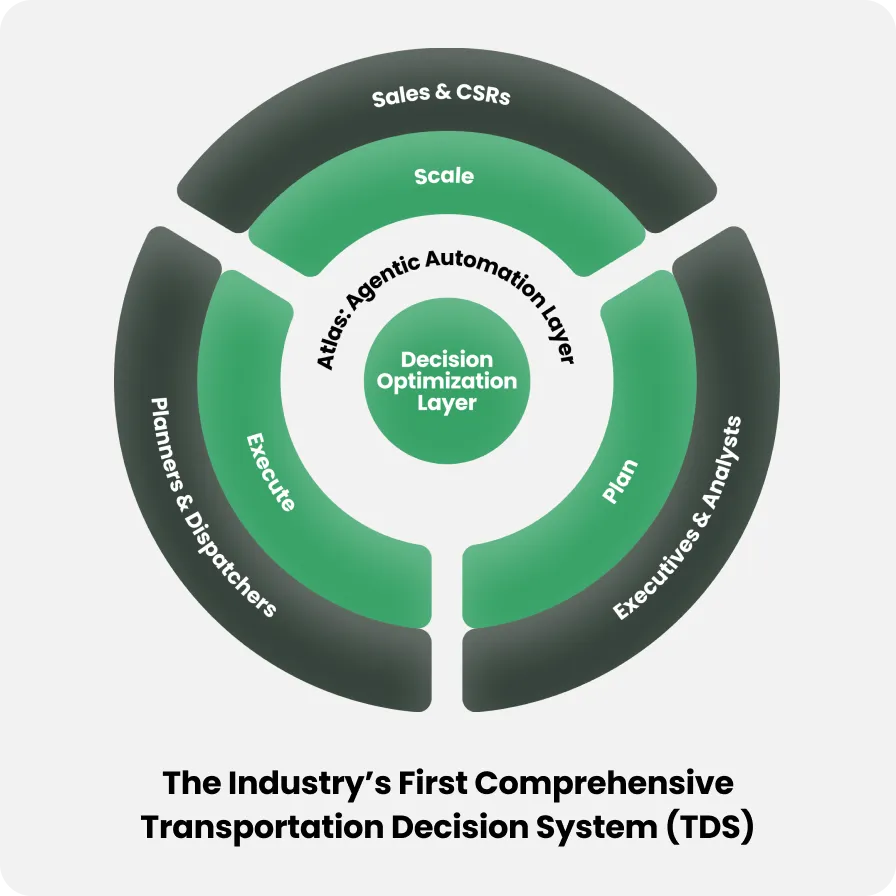
To improve those outcomes, AI-powered fleets are adopting a new category of software: the decision-native agentic system (DNAS). These systems uniquely combine decision intelligence with specialized AI agents that continuously evaluate freight opportunities, orchestrate decisions, and enhance network performance in real time.
Optimal Dynamics created the first DNAS for the transportation industry. Its platform, Scale, continuously evaluates freight opportunities and network trade-offs to make optimal decisions — then immediately procures the best-fit freight via digital channels.
2. Build a Unified Operational Data Foundation
Before deploying an AI-powered DNAS for freight procurement and planning, fleets must recognize that intelligent systems are only as effective as the data they depend on.
Fleets seeking to maximize the value of AI need a strong operational foundation that integrates transportation management systems (TMS), telematics, ELD platforms, and other operational technologies into a unified network view.
Accurate, real-time visibility is essential because freight decisions cannot be evaluated in isolation.
A load that appears profitable on its own, based on rate, lane, and distance, may quickly lose value once network conditions, such as lane balance, driver utilization, repositioning costs, and customer commitments, are considered.
This makes real-time operational visibility critical. Intelligent systems require accurate data on driver availability, equipment positioning, lane balance, projected capacity constraints, and customer service commitments to make optimal decisions.
Without connected systems and reliable operational data, fleets risk exacerbating inefficiencies rather than improving performance.
3. Move Beyond Task Automation to Decision Intelligence
One of the biggest misconceptions about AI in transportation is the assumption that automation and intelligent decision-making are the same thing.
Traditional automation tools focus primarily on repetitive tasks. For example, systems may automatically accept tenders from specific customers or process loads that meet predefined lane and rate criteria. While these tools improve efficiency, humans still make the decisions with the greatest network-wide impact.
Decision-native systems operate differently.
Instead of simply speeding up workflows, DNAS platforms autonomously assess whether freight decisions improve profitability, strengthen lane balance, protect service commitments, and optimize overall network performance.
At the same time, systems like Scale continuously evaluate freight opportunities and automatically procure and plan loads that best improve network performance.
This fundamentally changes the role of operations teams.
Rather than manually searching for freight and matching loads to available assets, planners and CSRs can shift to more strategic, control tower responsibilities, such as exception management, customer relationships, sales growth, and operational oversight.
4. Connect Procurement, Planning, and Execution
System fragmentation remains one of the biggest barriers to deploying next-generation AI technologies throughout fleet operations.
In many organizations, freight procurement, planning, and execution still operate across disconnected systems. When these workflows are siloed, decisions become misaligned, creating inefficiencies and operational disruptions upstream and downstream.
Integrated, autonomous systems solve this problem by continuously coordinating procurement, planning, and execution decisions in real time.
A DNAS platform like Scale constantly reshapes decision-making and operational execution as network conditions change. This network-aware approach enables fleets to evaluate every freight opportunity within the broader operational context.
Instead of reacting to disruptions after they occur, fleets using intelligent systems continuously plan to prevent downstream inefficiencies.
The result is improved service reliability, higher profitability, better network balance, and fewer operational disruptions across the organization.
5. Introduce Autonomous Decision-Making in Phases
For many fleets, autonomous decision-making understandably raises concerns about operational control and risk management.
Fortunately, AI-driven decision systems can be deployed incrementally and configured to align with operational comfort levels and business objectives.
Many fleets start with recommendation-based support, in which systems assess network conditions and suggest actions while planners and CSRs retain full decision-making authority.
Organizations can quickly move toward assisted decision-making, in which routine operational decisions are automated and only higher-level exceptions require human intervention.
As confidence grows, fleets can transition to autonomous execution, in which intelligent systems continuously evaluate freight opportunities, optimize network trade-offs, and execute procurement decisions with minimal manual intervention.
The operational benefits increase quickly.
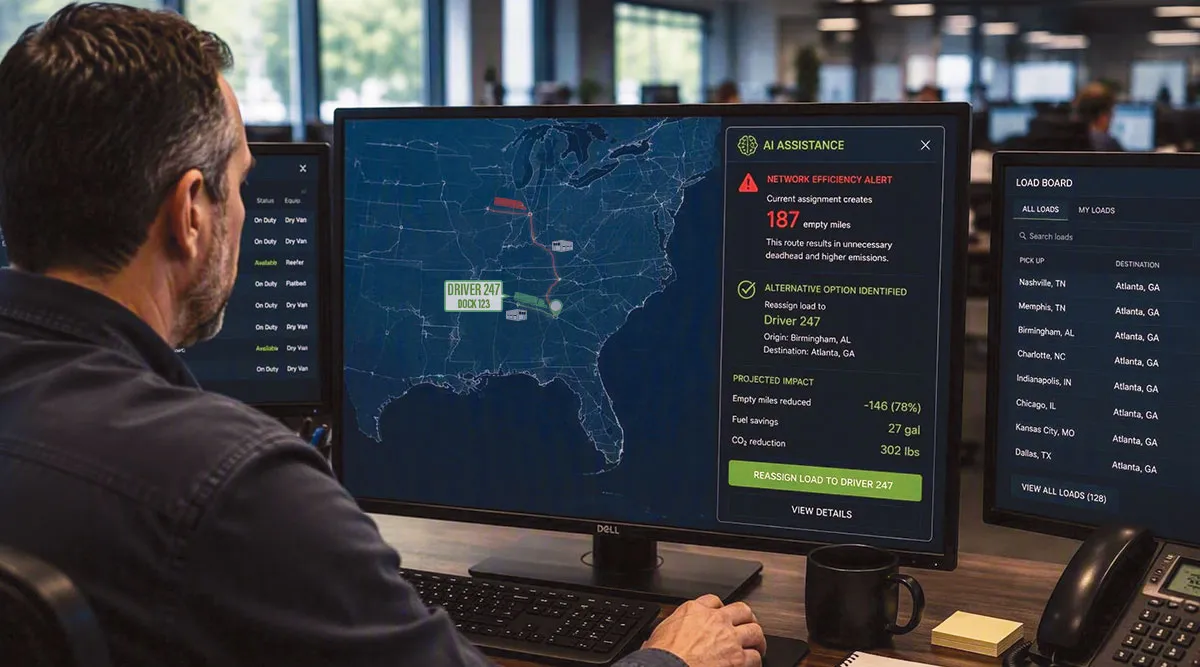
Fleets adopting autonomous, network-aware decision systems will consistently reduce empty miles, improve asset and driver utilization, strengthen service performance, and free operational teams to focus on higher-value strategic initiatives.
The Future of the AI-Powered Fleet
Decision-native agentic systems, such as Scale by Optimal Dynamics, mark the next phase in the evolution of AI-powered fleet operations.
Fleets that embrace this shift early will be better positioned to improve margins, enhance service reliability, optimize utilization, and adapt more effectively to evolving market conditions.
Discover how Scale can help your fleet transition from manual freight planning to autonomous, network-aware decision-making. Continuously optimizing procurement, planning, and execution in real time will reduce empty miles, improve driver and asset utilization, strengthen service performance, and drive more profitable growth across your network. Schedule a demo to see Scale in action.