

Employee Spotlight: Joe Durante
Tell us about yourself and how long you’ve been with Optimal Dynamics.
My name is Joe Durante, and I’m the SVP of Artificial Intelligence at Optimal Dynamics. I joined the company eight years ago. At the time, I was in Warren Powell’s research lab at Princeton, where I learned about his son Daniel’s new startup. The opportunity to apply math concepts from my research to the real world was too good to pass up. Ever since then, I’ve been obsessed with building Optimal Dynamics.
What are the biggest changes you’ve seen over the years with the company?

Besides the obvious change in size and scope of impact, our technology has evolved quite a bit over the years. We still sell better decisions; that is our bread and butter. We still apply the same core concepts to our simulation, optimization, and reinforcement learning decision engines. But the way our software interacts with the outside world has changed drastically, primarily on two fronts: deployment and enabling true automation of our decisions.
In the past, deployments required slogging through manual cycles of integration, input data validation, calibration, solution quality validation, and problem resolution. Now, once data feeds are set up, we are using reasoning agents to do everything from auto-solution design and document development, to “personalization” of the solution via historical pattern matching, to self-healing systems. As a result, the time-to-value for our customers has decreased by an order of magnitude.
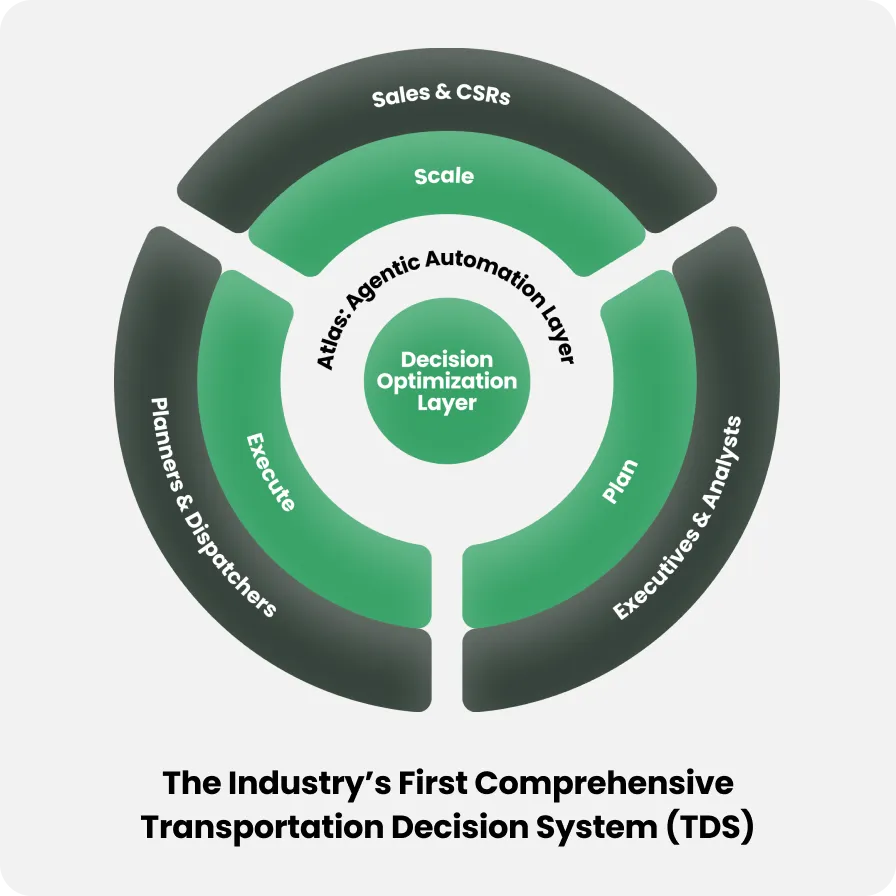
On the automation front, we are building a layer of execution intelligence around our centralized optimization software, comprised of agents. The marriage of the two very complementary technologies - traditional Operations Research (OR) and optimization software and LLM-powered agents - is what we call a Decision-Native Agentic System (DNAS). In complicated networks or complex, high-dimensional decision processes, LLM-based agents are not designed to fully capture how a single decision may impact the whole operation. On the other hand, optimization software tends to be brittle with respect to input data quality and lacks the ability to automate operational decisions that fall outside of happy-path execution (think any decision that is handled via person-to-person communication, such as email scheduling of appointments, bidding, dealing with a bit of gray area, etc.). However, together, an agentic layer with access to the centralized decision layer's optimization context can handle this execution ambiguity. It can act on its own, pulling more context from a centralized state when necessary, and, of course, asking for a human-in-the-loop in true edge cases as well. By handling the long tail of potential edge cases, we can drive solution adherence, and thus realized value of the solution, up towards 100% via automation.
This doesn’t even account for the solution-quality gains we can achieve by putting agents to work identifying and remediating unreliable or missing data points. For example, let’s say a driver’s location in one system is severely misaligned with the data point indicating the location of their currently attached load. We can let a voice agent call the driver to determine which data point to trust. Anyone who has worked with optimization engines knows the potential domino effect of even a few bad input data points. Agents unlock new methods of proactive remediation in real time that can do wonders for the system's overall usability.
Now, I do speak a lot about this technology in terms of how it helps solve the truckload trucking network planning and dispatching problem. However, I am excited about the extensibility of the principles to a broader class of resource allocation and sequential decision-making problems, with many applications in the supply chain and logistics space.
Can you briefly summarize your job?
On the technical side, I lead a team of AI engineers and OR scientists responsible for developing the engines that power our decisions and the agents that enable seamless automation of these decisions. I also ideate with product and other leadership about how to build new, innovative solutions for our current and future customers.
What do you like best about our company culture?
The team values problem-solving and has a collaborative culture. I enjoy working with bright people who do not shy away from tackling and solving difficult problems. The people are great, and I’m genuinely friends with a lot of my coworkers. The annual company offsite is a highlight of my year when we all get to relax and hang out for a few days.
What is unique about what we do at Optimal Dynamics?
High-dimensional sequential decision-making problems with high uncertainty is a really hard problem class for developing SaaS solutions. Many folks would have looked at the complexity involved in producing scalable solutions and pivoted to something else. We hit bumps along the way, but we have developed very impressive technology to solve problems in this class. I also believe that, with our new work developing decision-native agentic solutions, we have the opportunity to expand reach across trucking and a broader set of applications.
What is your favorite part of your job?
I enjoy the days where we spend a lot of time brainstorming about where to take our company and our tech over the next 3, 6, 12 months+. A more frequent source of joy comes in finding the best solution to a difficult problem and getting teams aligned on how to execute it. Once it all comes together and makes it to production, it is a very satisfying feeling. Perhaps even nicer is when a difficult problem comes my way and I can send it to a teammate whom I trust to find an elegant solution.
More recently, I’ve been enjoying spinning up multiple Claude instances and putting my short attention span to use in orchestrating a massive amount of dev work.
How does your work impact our product, and, therefore, the industry?
I am currently very involved in launching our new product, Scale. I believe it can fundamentally change how the carrier side (or any asset-based operation, including shipper private fleets) of the trucking industry does network planning. Carriers have a difficult problem - they need to plan an asset network, finding the right freight for their assets through a combination of long-term contracts, shorter-term bids, spot freight, customer boards, email tenders, etc. Not only do they need to find it, but they also need to bid the right price to maximize profitability, taking into account the probability of winning the freight and their level of urgency to win it. Each network need is itself a pricing problem with network impacts and vast uncertainty. It is actually amazing to me that people can do this with any degree of success.
Our new product Scale helps action network planning decisions to win more loads that are accretive to an asset-based network by orchestrating the correct amount of agentic procurement activity while reserving the right amount of capacity to satisfy current and forecasted committed freight. I suspect that with the rise of conventional agentic solutions and simply increased automation across the industry, speed to place and complete bids will soon be even more crucial. The fastest response time from new information to action is achievable only with a decision-native agentic system. Since one cannot simply unleash a swarm of unorchestrated agents, as they would risk significant overprocurement, conventional procurement agents or automations must still be manually invoked, monitored, and managed. Thus, procurement is limited by the speed at which humans can make decisions; put differently, humans are the bottleneck on the orchestration side. Scale leverages the optimization context to orchestrate the appropriate volume of agentic procurement activity, ramping up in some spatiotemporal regions while terminating others in response to new information about the network and the successes/failures of other correlated agent activity.
What do you like to do in your free time?
I enjoy being relatively active. Basketball and skiing are two of my favorite sports. On the weekends, I enjoy dinner and drinks with friends or family, and living in NY, you can always find something interesting to do. When we’re not running around, I always appreciate downtime with my wife, Ari, and our cat, Freya.
What’s the best advice you can give to someone who wants to work at Optimal Dynamics?
It is a great place to work, especially if you want to learn a new problem space and an innovative way of thinking about solving problems. Be ready to learn quickly and take ownership!