

AI Hype to Decision-Native Reality: Daniel Powell Discusses Scale on What the Truck?!?
Optimal Dynamics CEO Daniel Powell recently joined FreightWaves’ What the Truck?!? podcast to cut through one of the loudest conversations in freight right now: what AI can actually do for carriers … and where the hype falls apart.
The timing is relevant in 2026 as AI messaging is hitting the trucking industry from every direction. New tools launch regularly, each promising to transform operations. But as Daniel put it during the conversation, most of them are missing something fundamental (and it’s not more automation).
This article breaks down four key takeaways from Daniel’s appearance. It lays out a framework for how carriers can make better decisions, and it shares how Optimal Dynamics’ newest solution, Scale, the industry’s first Decision-Native Agentic System™ (DNAS), is built to deliver on that framework.
Here’s a look at four insights Daniel shared during his appearance on What the Truck?!?:
1. AI Without Context Doesn’t Solve Problems
One of the first distinctions Daniel drew was between tools that execute tasks and systems that actually make decisions. Most AI agents in trucking today do fairly basic things like tell you what call to make or what email to write. But they don’t understand why they should be doing any of it.
“They act more like a low-level person,” Daniel explained. “They rarely actually have context on what they should be doing. What is the objective that we’re actually trying to solve for?”
Without understanding a carrier’s goals, constraints, customer commitments, and network position, an AI agent is creating activity rather than outcomes. It’s the difference between sending 100 random emails versus sending the right five emails. Execution without context just creates noise with little hope for results.
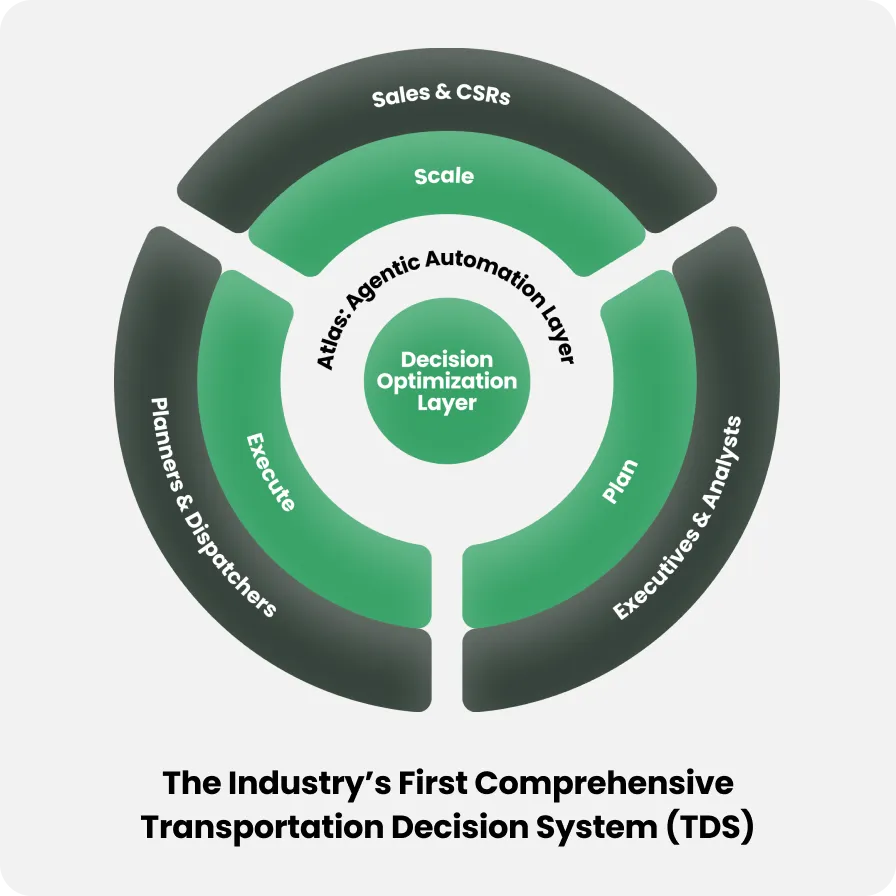
This is the core problem Scale was designed to solve. As a Decision-Native Agentic System, Scale understands what action the network actually needs before any agent is deployed.
2. The Real Shift to Smarter Decisions
Daniel went deeper on a point that most AI conversations skip entirely: The real problem is knowing how to prioritize automated tasks. For example, AI agents might know that they need to negotiate loads, but they rarely know which loads are most important.
“What load to even talk about in the first place needs another approach,” he said. “That’s where the decision-native layer comes in and says, ‘Hey, we actually need to go out and get a load that has these very specific parameters on this day to either get one of our drivers back home to service a major customer, or to keep our network profitable.”
Most modern tools are merely prompt-driven. Something happens, and the system responds. For example, a tender arrives, and the agent accepts or rejects it. Or a load appears on a board, and a bot bids on it. The problem with this approach is twofold:
- That’s an inherently reactive way to operate.
- This approach treats every load as a standalone decision.
Scale flips this model.
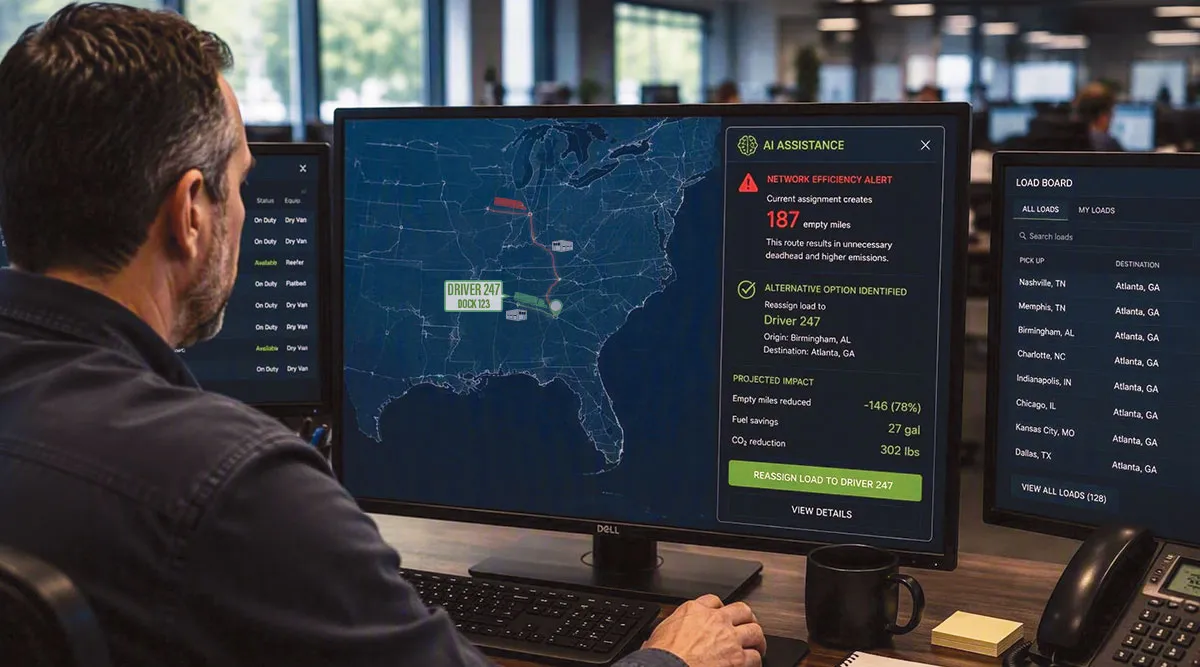
Optimal Dynamics’ decision optimization engine continuously evaluates a carrier’s entire network, including where capacity is tight, where imbalance is developing, and where additional freight is needed to improve utilization and profitability. From that foundation, Scale’s autonomous agents go to work by sourcing, negotiating, and securing the freight the network actually needs, across load boards, direct shipper channels, email, and EDI.
It’s the pairing of optimization (what to do) with proactive agentic automation (how to do it) that unlocks real value. Better execution doesn’t matter if you’re executing the wrong plan.
3. Operational Impact Shows Up in Revenue (Not Just Efficiency)
When the hosts asked where carriers feel the impact most across cost savings, revenue growth, and service, Daniel didn’t pick just one. That’s because Scale isn’t designed to optimize for just one of those things in isolation.
“This new tool is more than just a new approach to how to manage agents,” Daniel said. “It’s an end-to-end workflow on how CSRs actually go about their day. It’s managing contracts, contract compliance, EDI, tenders. It’s understanding network balance, network needs. And then on top of that, it’s going out and securing freight. So it’s managing profit, it’s winning revenue.”
That breadth is the point. Scale manages the entire order lifecycle, from tracking contract compliance to identifying where the network needs freight to securing it proactively. Managing profit and winning revenue aren’t separate problems when the decisions are connected.
And the automation is significant. Powell cited roughly 80% of manual CSR workflows are handled by the system, freeing teams to be redeployed to higher-value activities like strategic customer work, exception management, and relationship-building.
When the underlying decisions are better, your business is able to secure the right freight at the right time — and the efficiency gains follow naturally. While too many trucking companies fall into the trap of automation for automation’s sake, the real benchmark should be better network performance.
4. AI Is Powerful (But Only When Applied Correctly)
Daniel closed with a grounding message for carriers navigating the current wave of AI noise.
“While AI often feels like magic, it’s not,” he said. “It’s just another tool.”
The industry is being flooded with AI messaging, and much of it is undifferentiated. The challenge for carriers is knowing which tools solve which problems. Misapplied technology creates confusion and underperformance, but the right application paired with the right problem creates a genuine competitive advantage.
Scale represents that right pairing: the intelligence of Optimal Dynamics’ optimization engine, built on more than 40 years of research originating at Princeton University, combined with the flexibility and speed of autonomous agents. It’s not AI for AI’s sake. It’s automated decision intelligence applied to the specific, complex problem of running a profitable truckload network.
Taking Action: What Carriers Should Do Next
The carriers who win in this next chapter will be the ones who use technology with the most discipline.
That starts with fundamentals like understanding your network, your constraints, and your goals. Focus on chasing outcomes rather than shiny objects, and recognize that the real opportunity is improving how decisions get made across your operation.
Scale was built for that mindset. It’s the industry’s first Decision-Native Agentic System, and it gives carriers of every size the ability to move from reactive freight procurement to proactive, network-aware decision-making.
Learn more about Scale, and discover how it benefits carriers today.