

5 Change Management Lessons From Fleets Doing Tech Adoption Right
Buying technology is the easy part. Getting everyone in your operation to change how they work is where transformations succeed or fail.
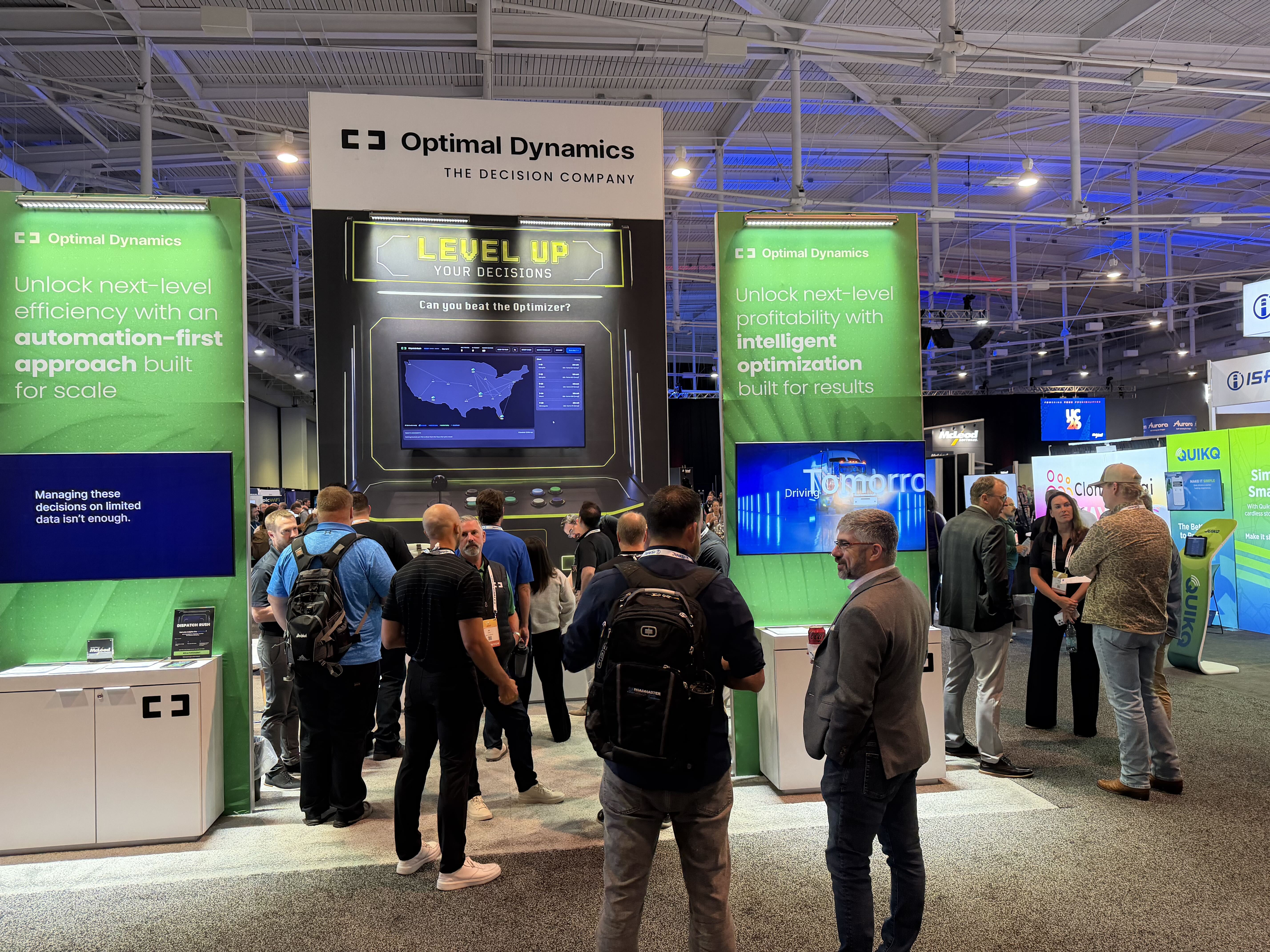
That challenge took center stage at the 2026 Optimal Dynamics User Conference in the “Strategies for Managing Tech Adoption & Change Management” session, which brought together leaders at very different points in the same journey: one live and scaling, one deep in implementation and preparing for go-live.
Tegan Johnson is Director of Fleet Operations at UFP Transportation, the transportation arm of UFP Industries, a Fortune 500 company that spans retail, packaging, and construction. UFP Transportation runs more than 450 power units and roughly 3,000 trailers, and has spent the last 3 years centralizing transportation operations that were once scattered across the enterprise. UFP is live with Optimal Dynamics and in active rollout.
Zahi Mitri is VP of Innovation & Technology at Challenger Motor Freight, one of Canada’s largest privately owned carriers and a member of the Fastfrate Group of companies. Challenger has right-sized its fleet to about 1,000 power units and is implementing Optimal Dynamics.
Between them, the session produced a candid, practical playbook for anyone trying to make automation and optimization stick. Here are the 5 lessons that stood out.
1. Prove It Before You Promise It
Neither company tried to sell the project internally with big promises. Instead, both companies leveraged proof to make the case for digital transformation.
For UFP, that proof came through the proof-of-value process. “Stakeholder buy-in was pretty easy once we did the POV,” Tegan said, whose team presented conservative financial projections rather than overselling. The centralization effort had already exposed waste and opportunity across the network; the POV process demonstrated that the platform could help eliminate waste and capture opportunity.
Challenger went even deeper. Zahi’s team built what he described as a very robust cost-benefit analysis, which included a time-series model of how adoption would ramp up. The rigorous analysis proved invaluable as the team advocated for the project.
“Once we understood it, we could speak to it with a lot of conviction,” Zahi said of the decision science behind the platform.
For both leaders, evaluating the platform went beyond just numbers. Tegan put it plainly when describing what set Optimal Dynamics apart in a crowded selection process:
“The product stands on its own, but it’s the cultural fit and the way that you guys approach the team as well that really set it over the top for us.”
That’s a consistent theme for fleets evaluating decision automation: the proof-of-value process exists precisely so operations leaders can build their internal case on demonstrated results from their own network.
2. Your Executive Sponsor Can’t Come From IT
Many fleets consider choosing an executive sponsor from IT. Zahi said during the session that that’s a mistake.
“You need that really good corporate sponsor at the top, and it can’t be the IT team. It really can’t be. It needs to be from operations.”
At Challenger, that sponsor is the EVP of Operations. The logic is straightforward: Credibility is essential for a program that will change how planners plan and how drivers run their weeks. When the sponsor sits in IT, the organization views the project as a systems initiative. When it sits with operations, the organization views it as the new way the business runs.
3. Restructure Before Go-Live (Not After)
UFP made a bold move by redesigning the entire organization before the platform went live rather than after.
There was real angst as UFP built a brand-new structure, Tegan said. People worried the technology would change or replace their jobs, and UFP’s answer was to confront the question directly. Every role was evaluated as part of the reorganization, and new roles were created. For example, UFP created the role of Fleet Optimization Manager, a title UFP adapted from an idea Tegan heard at the 2025 Optimal Dynamics User Conference.
“I strongly believe that whatever your title is should indicate what you actually do,” Tegan said.
Today, his team plans exclusively in the platform using a structure that was set months before the rollout to new regions.
At the time of the session, Zahi was candid that organizational design is the part of the journey the team is still working through. Challenger is evaluating system performance first before exploring reorganization. While these two companies are taking different approaches and using different processes, each is rebuilding around technology.
4. Automate First, Optimize Second
Both leaders endorsed a crawl-walk-run philosophy with an emphasis on this point: trust is sequential.
Zahi said that people must trust that the automation works before they can talk about optimization. Near end-to-end testing, the Challenger team started to develop that level of trust.
“That allows us to then talk about, ‘OK, now let’s tune it. Now let’s talk about how do we make it better from a plan perspective.’”
Only after the team trusts the automated baseline, he argued, can you productively tackle the harder questions around the internal politics of which divisions share which freight.
UFP had implemented a new TMS just before rolling out Optimal Dynamics. That experience, which felt rushed, taught them that they needed to be intentional about pacing. UFP started in a location where success and buy-in were likely, validated data accuracy and solution quality, and only then expanded. That deliberate pace has protected the business during the transition.
5. Measure Trust (Not Just Dollars)
The session closed with a discussion of KPIs. The panelists’ answers revealed a sophisticated thought process around ROI.
Challenger is laser-focused on one macro metric: revenue per truck per week. Zahi argued it drives everything else downstream, and he pushed back on one of the industry’s most common measures.
“With all due respect to deadhead, I think it’s a bit of a red herring,” he said.
Challenger plans to track platform adoption itself as a KPI on the logic that trusting the model will help them win over time. The more consistently the team works inside the platform, the higher the ROI.
UFP is using a similar approach. Planner metrics are now tied to optimal matches and best matches, alongside a deliberate campaign against an old habit.
“They’re searching for freight, searching for freight, searching for freight. Those are the bad habits that we’re trying to get the tool to break — on purpose.”
A planner who builds a plan outside the system, Tegan explained, bypasses the optimization entirely. He’s targeting a measured 70% adoption, a level that would still drive substantial efficiency for UFP’s business. His advice to other fleets is this: “I would strongly encourage that any customer be realistic in their approach as they go through the metrics, and you define them for yourselves.”
Start Your Proof-of-Value Process
Both UFP and Challenger are at different points in their journeys with decision automation, but both have the same motivation. Each believes that the fleets that manage change deliberately will be the ones positioned to win in the coming years.
Learn how the proof-of-value process helps operations leaders build their own case when you schedule an Optimal Dynamics demo.